








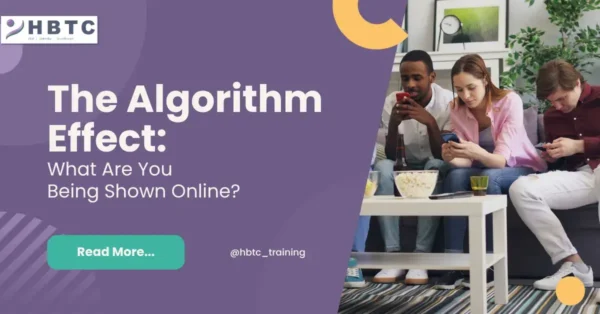
The Algorithm Effect: What Are You Being Shown Online?
Social media is a huge part of everyday life. Platforms such as TikTok, Instagram, Snapchat, and X can help us keep in touch, discover new interests, follow news and entertainment, and express ourselves.
But have you ever wondered why certain things appear on your feed?
Social media platforms use algorithms to recommend content based on what you watch, search for, like, comment on, share, and interact with. The more you engage with a particular type of content, the more similar content you may be shown. Most of the time, this can be useful. If you enjoy football, music, cooking, or gaming, your feed can become better at finding things you are interested in. However, recommendation systems can also create problems when the content attracting the most attention is shocking, controversial, or emotionally charged.
The Algorithm Learns What Grabs Your Attention

Think about the posts that make you stop scrolling. They might make you laugh or surprise you, but they could also make you angry, worried, or frightened. Strong emotions can encourage us to watch for longer, read comments, respond, or share content. This interaction gives the platform information about what holds our attention. Recent reporting by the BBC, including interviews with former social media employees and whistleblowers, has raised concerns about how engagement-driven algorithms can amplify harmful or divisive content. The companies involved have disputed a number of the claims and point to the significant investment they make in online safety and content moderation.
The wider issue is important: if a recommendation system learns that a particular type of content keeps your attention, it can show you more of it. This can sometimes create a “rabbit hole” effect. You might watch one video because it interests you, followed by another on a similar subject, and then another. Over time, your feed can become increasingly focused on the same topic, idea, or viewpoint, even if you never deliberately searched for it.
Don’t Confuse Popularity with Truth
Something appearing repeatedly on your feed doesn’t make it true. Young people can encounter misinformation, conspiracy theories, bullying, hateful material, and other harmful content alongside ordinary entertainment. A video with millions of views isn’t necessarily accurate, and having a large following doesn’t automatically make someone an expert.
Before believing or sharing something, pause and ask:
- Who created this content?
- Why has it appeared on my feed?
- What is it trying to make me feel?
- Can I check the information somewhere else?
- Am I seeing more of this because I’ve interacted with similar content?
Why Does This Matter in an Apprenticeship?
Starting an apprenticeship is an important step towards independence. You’re developing your career, gaining new skills, meeting new people, and taking on responsibilities in the workplace. That means what happens online can sometimes affect what happens offline. Something posted as a joke can have consequences for another person. Sharing inappropriate content can affect your reputation or professional relationships. Misinformation can influence how we understand important issues, while repeated exposure to harmful or extreme content can affect the way we view other people and the world around us.
Your digital behaviour is part of your wider professional behaviour. Employers and training providers have a responsibility to support a safe and respectful environment, and apprentices also have a responsibility to consider how their online actions may affect themselves and others. Being digitally aware doesn’t mean avoiding social media. It means understanding how it works, thinking critically about what you see and knowing when to step away.
What can Employers and Training Providers do?
As an apprenticeship and training provider, we have an important role in supporting apprentices’ wider development, safeguarding and wellbeing. We want apprentices to feel able to ask questions, challenge information and raise concerns without fear of being judged. If something you encounter online concerns you, makes you uncomfortable, or begins affecting you or someone else, speak to someone you trust. This could be a member of your training team such as your tutor/assessor, your employer, a safeguarding lead or another trusted adult.
These conversations can also support wider Prevent work. Prevent is about early support for people who may be vulnerable to radicalisation. It is not about labelling someone because of something they have watched or read online. There is rarely one single reason why someone becomes vulnerable to harmful influences. Online content can be one factor among many. Creating an environment where apprentices can talk openly, ask questions, and seek support is therefore an important part of safeguarding.
Remember
Take a break if scrolling is making you angry or upset. Use tools such as “Not interested”, mute or report features to manage unwanted content. Follow a variety of reliable sources and check information before believing or sharing it.
Your feed is learning from you; make sure you’re learning to question it too.
You may also be interested in…

Emily Simpson
Emily is our Marketing & Engagement Officer and is involved with all things social media and content development. She is also responsible for attending career events and maintaining relationships with local schools and colleges.